CX Field Notes7
Requirements gathering never stops — and it starts with empathy. These are my field notes from the other side of the counter: moments where a product honored the user's time and trust, and moments where it didn't. My approach to understanding problems is grounded in empathy and emotional intelligence — feeling what the user feels before naming the pattern — because you can't fix an experience you haven't understood. Each case ends with the principle I carry into my own projects. CX here includes UX and UI: everything from an interface detail to a support channel shapes how a product treats its people.

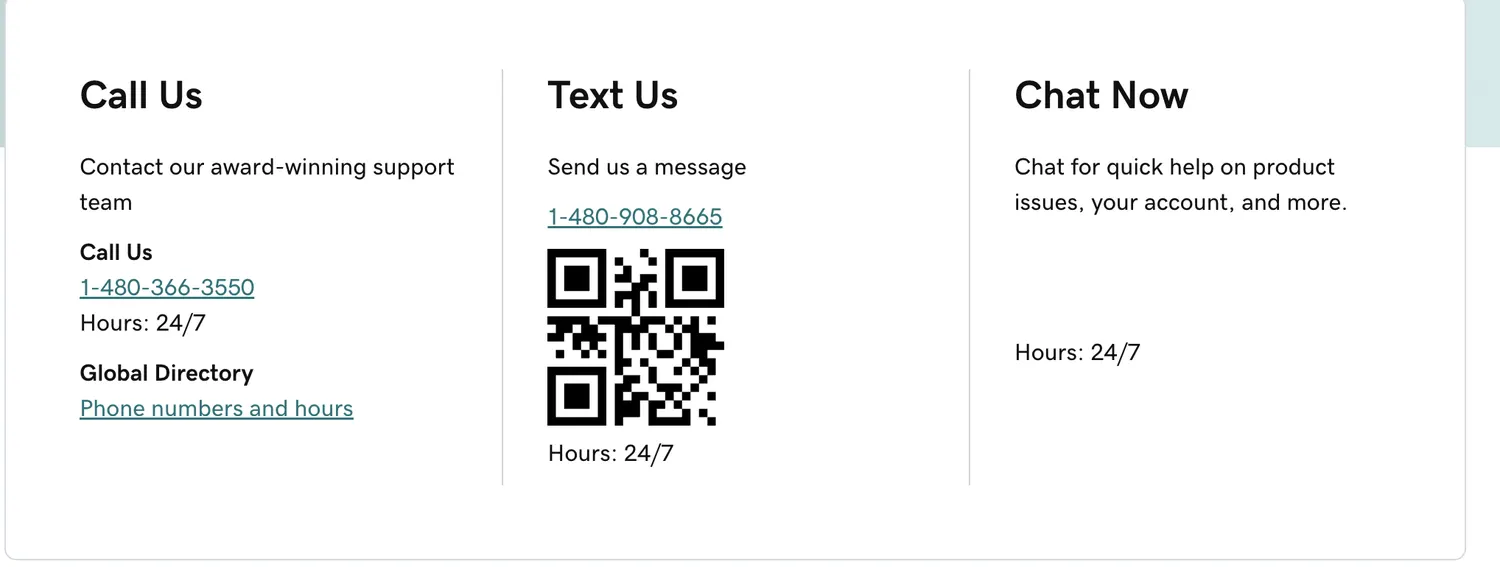
“Chat Now” — with nothing to click
The third column promises chat for quick help, available 24/7 — and renders no button, link, or widget to start one. A heading styled like an action with no action behind it sends users hunting through the page, and then into the phone queue the chat was supposed to relieve.
The principle: A call to action must contain the action. Never advertise a channel without rendering its entry point.
A text line that never texts back
The page offers an SMS number — complete with a QR code and 24/7 hours — but messages sent to it get no response. An advertised channel sets an expectation the moment it is printed; silence afterward costs more trust than never offering the channel at all.
The principle: An unstaffed channel is worse than no channel. Publish only the paths someone actually answers.
AI agents that can't reach the problem
Phone support promises a response time it doesn't keep, then routes callers toward AI agents — which couldn't resolve an account-level issue: a DNS record locked by GoDaddy's own product. The promised follow-up text to connect with a virtual agent never arrived. A task the support flow couldn't finish stretched from minutes into days.
The principle: Automation should absorb the easy cases so humans get the hard ones faster — not stand between the user and resolution.

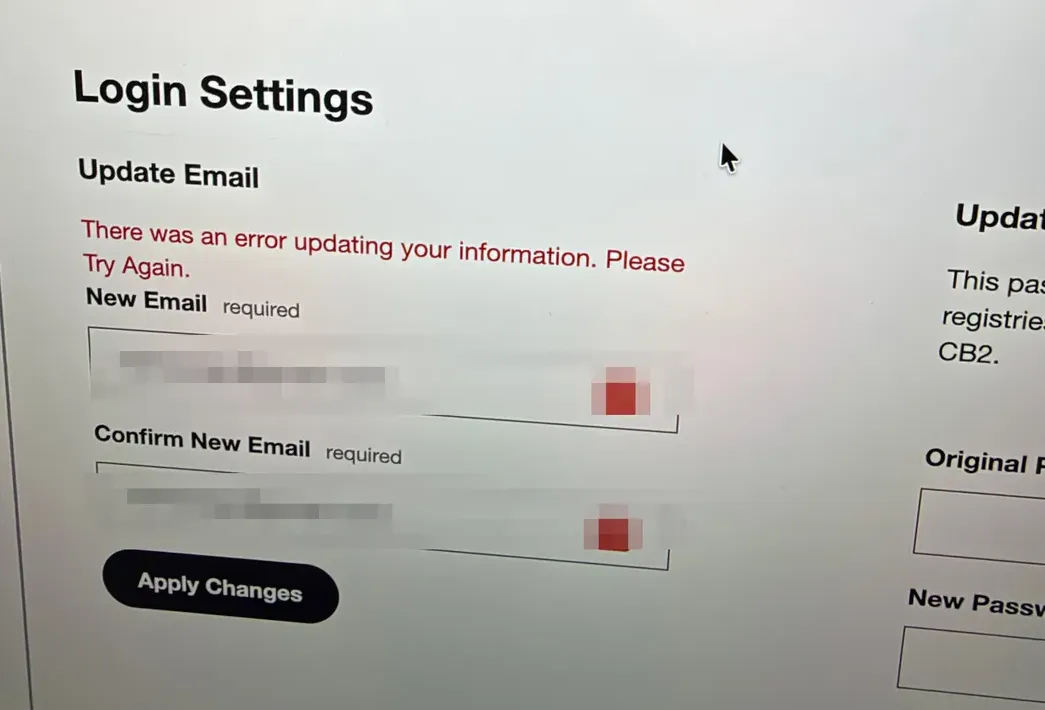
“There was an error. Please Try Again.” — for days
A simple email change fails with the same generic message every time: no reason, no error code, no path forward. Days of retries — incognito windows, different browsers — ruled out everything on the customer's side, and the message still offers nothing but “try again,” which by then is a proven dead end.
The principle: An error message is an interface, not an apology. Say what failed, whose fault it is, and what to do next — or one bug becomes an endless loop.
Support that declares victory — repeatedly
Text support said it was fixed “now.” Then to wait 48 hours. Then to wait until a specific date. Each promise expired without the fix, and each new contact restarted the script from the top. A promised resolution that doesn't arrive teaches the customer to distrust the next one — and the brand behind it.
The principle: Never close the loop before the problem closes. Verify the fix, then say it's fixed — a slow honest answer beats a fast false one.
The official remedy: create a new account
After the lowest possible mark on their own CX survey, the response was a suggestion to create a new account — abandon the history and settings attached to the old one so the company wouldn't have to repair its own bug. That outsources the full cost of the defect to the person it already hurt.
The principle: When your system fails, the remedy must cost you, not the customer. “Start over” isn't support — it's surrender, billed to the user.

A broken iPhone in Europe, fixed like it was home
Mid-vacation in Europe, a dropped iPhone and shattered glass. Walking into a local Apple Store, the whole experience — the booking, the Genius Bar flow, the way the problem was handled — worked exactly as it does in the US, and the phone was replaced within a few hours. No special pleading, no “not your region,” nothing to re-learn. The brand's promise traveled with the customer.
The principle: Consistency is a feature. When a customer can predict your process anywhere in the world, trust compounds — the experience itself becomes the brand.